
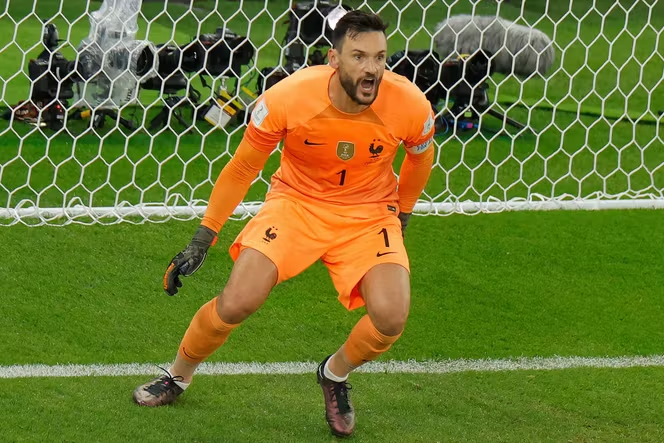
How the World Cup Turns Quiet Colleagues into Daily Football Analysts
When coworkers who barely spoke suddenly start talking about the World Cup every day, football becomes more than a distraction; it turns into a shared framework for reading pressure, structure, and performance at work and on the pitch. As they rewatch incidents together in their heads and at the office TV, their conversations begin to mirror the way analysts break down matches, even if nobody uses that label.
Why Shared Kickoff Times Create a New Office Rhythm
Group-stage kickoffs and knockout schedules give the workplace a temporary, predictable calendar that many colleagues plug into without needing a meeting invite. People begin to time coffee breaks around half-time, finish tasks just before kick-off, and drift toward the same screen in the break room as if pulled by gravity.
That shared timing changes how they experience the game. Everyone has seen roughly the same minutes live, so post-match talk naturally focuses on phases rather than only final scores: the spell of pressure just after a goal, the period when a team could not play out, or the last ten minutes when line height became visibly conservative. The World Cup turns time itself into a common reference point for analysing what they watched.
How Casual Match Talk Evolves into Structural Analysis
Early in a tournament, office conversations tend to be simple—favourite teams, star players, surprising results. But as people keep watching, repetition pushes them toward deeper questions: why a pressing side suddenly stopped winning the ball high, why a supposedly defensive team created so many chances, or how a substitution flipped momentum.
In practice, that means colleagues move from “We were bad” to more precise observations about spacing, compactness, and transitions. Someone mentions how far the full-backs pushed, another comments on the holding midfielder’s positioning, and soon they are collectively reconstructing passing patterns from memory. Over a few days, the group’s football vocabulary grows, and so does its ability to map cause–effect from tactical choices to on-pitch outcomes.
When Watching Live Changes the Way You Talk the Next Morning
Office conversations after a game are very different when everyone watched full live minutes rather than just highlights. People remember the build-up to big chances, the repeated attempts to exploit a particular flank, and the sequence of turnovers that led to a decisive counter. That shared memory allows for more granular debate: did the team lose control because the press dropped, or because the front line stopped offering runs?
If you watched ดูบอลสด the night before, you can draw on specific moments: a series of failed switches of play, a spell where the back line could not step out, or a run of attacks where no midfielder arrived late in the box. Describing these sequences to colleagues forces you to articulate what you saw in structural terms, which in turn sharpens how you will watch the next match—looking for confirmation or contradiction of your own reading.
Key Match Topics That Turn Coworkers into Regular Analysts
Certain recurring themes almost always surface when colleagues debrief World Cup games, and each one nudges them closer to thinking like analysts, even during small talk in the hallway.
- Shape without the ball – Was the team defending in a high press, mid-block, or deep block, and did that change after scoring or conceding?
- Transition strength – How dangerous did counters look, and how many players consistently joined them?
- Use of width – Did full-backs and wingers stretch the pitch, or did the team crowd the centre and become predictable?
- Set-piece impact – Were corners and free-kicks organised with clear routines, or improvised and easy to defend?
- Game management – After taking the lead, did the team manage tempo and territory, or invite pressure by dropping too deep?
Every time these topics come up, colleagues refine their shared template for what “good” and “bad” looks like in each area. Over a tournament, this collective framework becomes the lens through which they watch every subsequent match.
How Different Roles in the Office Map to Different Ways of Watching
People bring their working habits into how they discuss football. The data-minded colleague might care about shot volume and chance quality, another might focus on body language and intensity, while someone used to managing teams may pay particular attention to substitutions and in-game tactical tweaks.
As they compare notes, each perspective adds a layer: one person explains why a low xG game still felt dominant because of field tilt, another highlights repeated pressing triggers, and a third notices how quickly the captain calmed things after setbacks. The more these angles are shared, the more complete the group’s understanding of the match becomes, and the easier it is for quieter colleagues to join in with specific, concrete observations rather than vague opinions.
When Office Allegiances Make You Watch More Carefully
In workplaces where people support different countries, every World Cup match becomes a social event with clear “sides.” That dynamic increases the incentive to watch closely: nobody wants to come in the next morning and rely on superficial impressions when colleagues will challenge details about pressing, line height, and why a coach chose one shape over another.
Knowing you will have to defend your view pushes you to pay attention to patterns across the full 90 minutes, not just the highlight moments. You start noting where turnovers occur most often, how regularly your team gets overloaded on a particular wing, and whether a tactical switch actually changes how the ball moves into the final third. The social pressure for accuracy thus improves individual match reading.
How Daily Match Talk Builds a Shared Tactical Vocabulary
As coworkers discuss games day after day, they gradually standardise certain terms and ideas. Phrases like “we lost the midfield,” “they overloaded the left,” or “the press stopped on 70” become shorthand that everyone understands. Behind each phrase sits a cluster of images—spacing between lines, repeated passing sequences, or how often the ball entered specific zones.
This emerging shared vocabulary feeds back into how people watch games in the evenings. When they hear a colleague complain about “no support around the striker,” they start watching more carefully for third-man runs and midfield arrivals in the box. When someone praises “control without chances,” they look for how often their team forces backward passes and keeps the opponent in non-threatening areas. The office talk trains their eyes for the next match.
Summary
The World Cup can turn coworkers who barely exchanged greetings into people who dissect matches together every day. By watching full games and then revisiting pressing patterns, line shapes, transitions, and substitutions in the office, they build a shared way of reading ดูบอลสดคืนนี้ โกลแดดดี้ that grows richer with each conversation. What begins as small talk about results becomes an ongoing, collective analysis that changes how everyone in that workplace watches live matches long after the tournament ends.